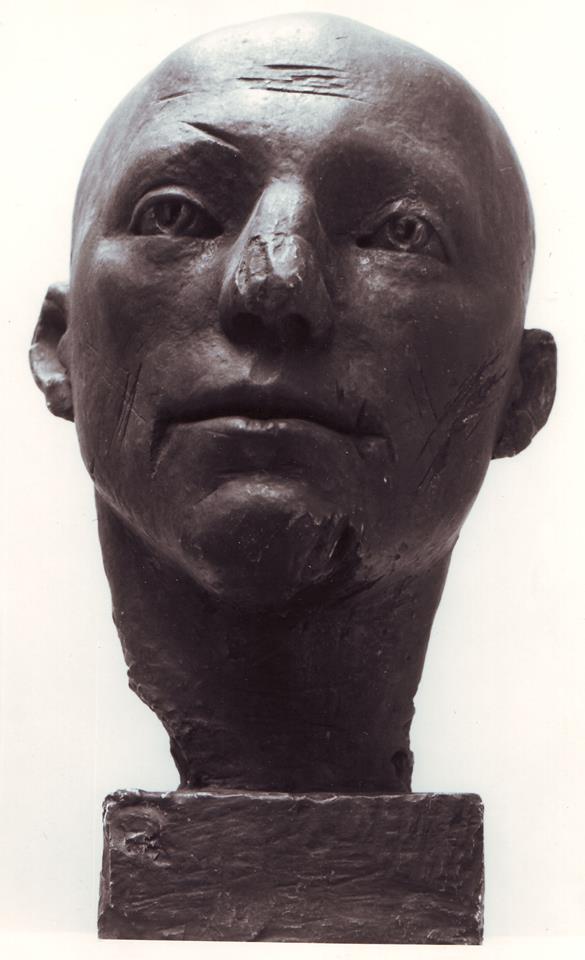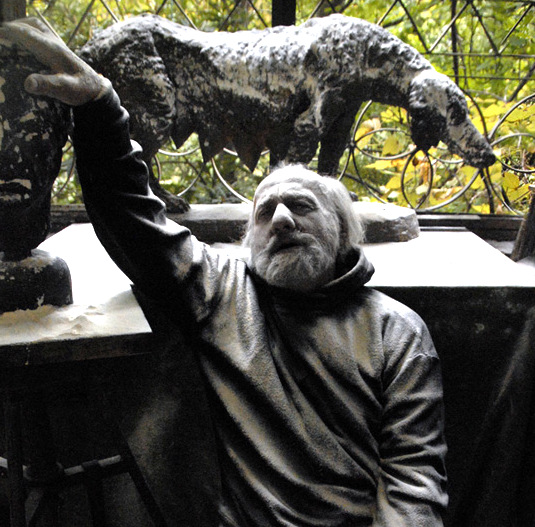

Sculpture was the principal focus of Simon (Siko) Girkelidze’s artistic practice; he also worked in painting and graphic art and illustrated books.
Portraiture, mythological and religious subjects, animal imagery, and a critical engagement with Soviet reality occupy a prominent place in his sculpture.
Girkelidze’s sculptures are characterized by expressive forms, irony, and grotesque imagery. Particularly notable in this respect is the composition Soviet Dog (1976, plaster, Georgian National Gallery), which depicts a stray bitch that has recently given birth. The work invests the image of the Capitoline Wolf with an anti-imperial meaning and can be interpreted as a critical allegory of the Soviet socioeconomic system.
Girkelidze initially studied at the Faculty of Geology and Geography of Tbilisi State University. During his student years, he worked with Lado Gudiashvili. In 1963, he held his first solo exhibition at Tbilisi State University. He subsequently continued his education at the Faculty of Graphic Arts of the Tbilisi State Academy of Arts, graduating in 1970.
From the outset of his career, Girkelidze worked in painting and graphic art alongside sculpture. His family collection holds more than one hundred paintings, including abstract compositions created in the 1970s that attest to his interest in formal experimentation beyond the confines of official Soviet aesthetics.
Among the sculptures he created in the 1970s and 1980s are Portrait of Polikarpe Kakabadze (1971, bronze), Portrait of Shalva Matuashvili (1974, plaster), Poseidon (1975, bronze), and Dog of the Soviet Union (1976, plaster), as well as the bronze tondi Dante and Voltaire.
During the post-Soviet period, two of Girkelidze’s public works were installed in Tbilisi: a bust of theatre director Kote Marjanishvili near the theatre that bears his name, and a bust of playwright Polikarpe Kakabadze on Davit Aghmashenebeli Avenue.
Girkelidze’s later paintings include Those Who Were Washed Away, Barbed Wire, The Wall, Elephant, and The Tower.
Girkelidze illustrated several publications, including Zurab Kiknadze and Tamaz Chkhenkeli’s translation of The Odyssey, The National Foundations of Georgian Romanticism, and a two-volume collection of works by Polikarpe Kakabadze.
During the late Soviet period, Simon Girkelidze, Karlo Grigolia, Neveli Jikia, and Otar Chkhartishvili founded the association Avant-Garde at the Artists’ House. From 1988 to 1991, Girkelidze’s sculptures were displayed there as part of a permanent exhibition organised under the auspices of the association. The works were destroyed in 1991, when the Artists’ House was consumed by fire during the Tbilisi Civil War; two works that survived the exhibition are preserved in the family collection.
Following the dissolution of the Soviet Union, Girkelidze served on the governing board of the Georgian Artists’ Union. In 2009, he won a competition in Mecklenburg-Vorpommern, after which his works were exhibited at the Solar Centre.
Simon Girkelidze’s works are held in the Georgian National Gallery, as well as in state and family collections.